
Clinical Application
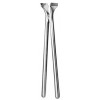
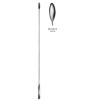
Designed for fine, controlled incisions in confined anterior segment anatomy, the sickle geometry is commonly used in ophthalmic procedures to create paracenteses, limbal or corneal entry wounds, conjunctival incisions and other delicate lamellar dissections. The pointed tip facilitates precise initial entry while the curved cutting edge enables a smooth slicing motion along curved tissue planes, helping reduce tissue drag and enhance control in microsurgical steps.
Design & Configuration
The curved (sickle) blade concentrates the cutting edge on the concave face, allowing a draw-cut technique that gives the surgeon tactile feedback and a predictable incision trajectory. The pointed tip provides accurate point penetration and controlled extension of the incision. The overall 15 cm length balances reach and ergonomic handling on the sterile field, enabling comfortable manipulation with standard surgical grips used in anterior-segment work.
Instrument Specifications
- Instrument type: Surgical sickle knife for precision incisions
- Pattern / model: Tabb Sickle Knife
- Configuration: Single-ended, curved blade with pointed tip
- Length: 15 cm
- Typical use: Corneal, conjunctival and scleral/paracentesis incisions; lamellar dissection
- Material: Surgical-grade stainless steel
- Reusable: Yes
Material & Construction
Manufactured from surgical-grade stainless steel with a precision-ground cutting edge to provide a sharp, long-wearing blade geometry appropriate for repeated use and reprocessing. The one-piece feel and balanced profile support fine manual control essential for microsurgical anterior-segment work.
Quality & Compliance
Manufactured by FDA-registered OEM facilities and produced under strict quality control standards.
Brand Comparison
Comparable in form and function to equivalent instruments offered by major US medical suppliers.
Availability & Returns
- In-stock lead time: ships within ~1 week
- Out-of-stock lead time: 2–4 weeks
- Returns: 30-day return policy