
Clinical Application
This instrument is designed for controlled curettage of superficial soft tissue and cutaneous lesions. It is commonly used in dermatology and minor surgical procedures for removal of hyperkeratotic tissue, granulation tissue, cyst lining, or for obtaining curettage specimens for histology. The small-profile working end supports precise, localized scraping where preservation of adjacent tissue is required.
Design & Configuration
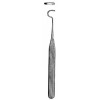
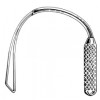
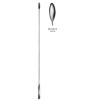
The scoop or loop-shaped working end provides a defined scraping edge and a shallow bowl to capture tissue shavings during curettage. This geometry allows the operator to modulate depth and pressure, improving tactile feedback and control during incremental tissue removal. The Fig.1 designation identifies a specific small-profile configuration intended for fine, precise work on superficial lesions.
Instrument Specifications
- Instrument type: Curette (scoop/loop working end)
- Pattern / model: Piffard Lupus Curette Fig.1
- Configuration: Handheld, small-profile working end for precise curettage
- Tip / jaw pattern: Spoon-shaped loop for scraping and tissue capture
- Typical clinical use: Dermatologic curettage, lesion debridement, biopsy sampling
- Material / construction: Surgical-grade stainless steel
- Reusable instrument
Material & Construction
Manufactured from surgical-grade stainless steel to resist corrosion and tolerate repeated sterilization cycles. The working end is formed for a smooth, burr-free edge to provide consistent scraping performance while minimizing inadvertent trauma to surrounding tissue. Designed for durable, reusable service in clinic and operating-room environments.
Quality & Compliance
Manufactured by FDA-registered OEM facilities and produced under strict quality control standards.
Brand Comparison
Comparable in form and function to equivalent instruments offered by major US medical suppliers.
Availability & Returns
- In-stock lead time: ships within ~1 week
- Out-of-stock lead time: 2–4 weeks
- Returns: 30-day return policy