
Clinical Application
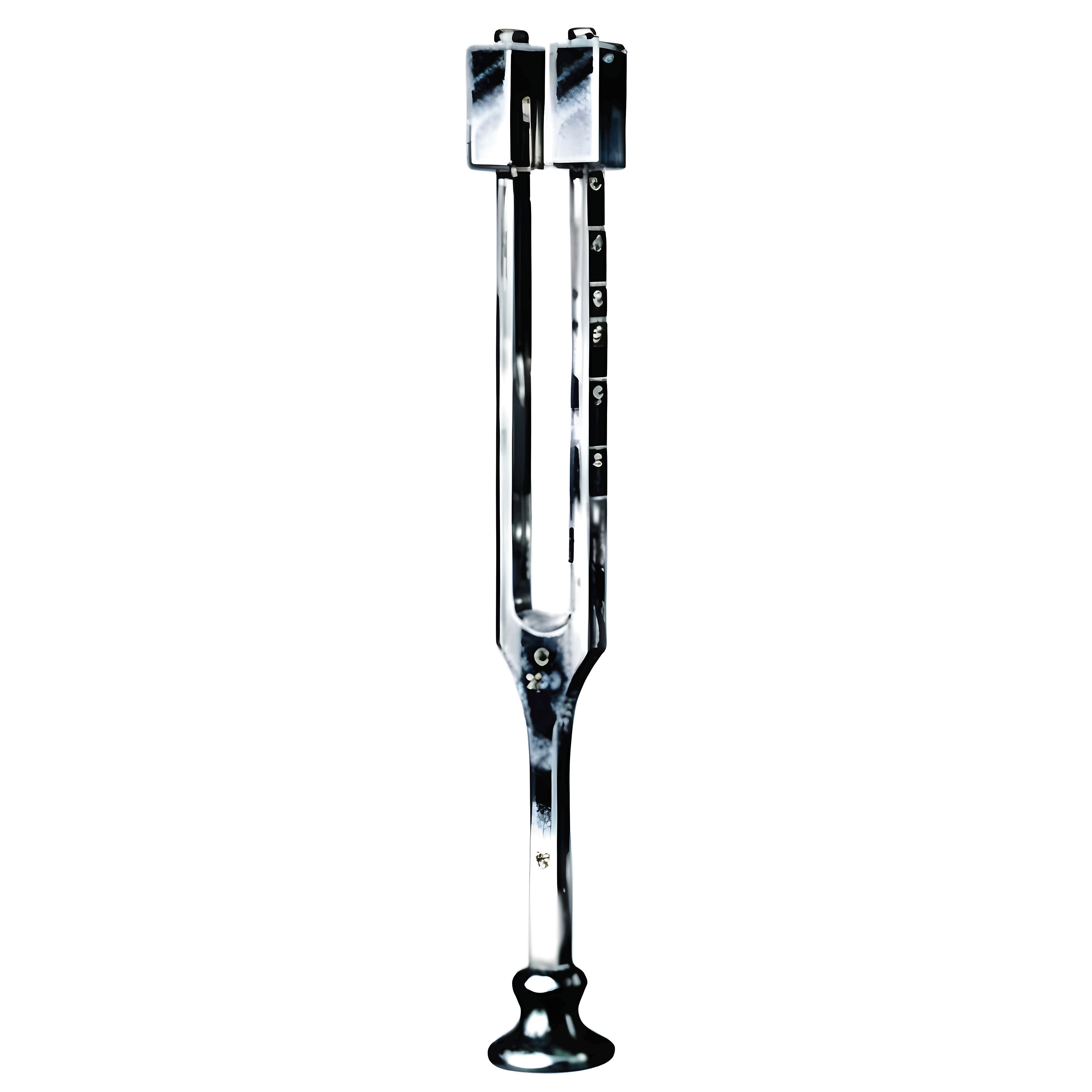
This 128 Hz tuning fork is intended for clinical assessment of vibratory sensation and proprioception at the bedside. The low-frequency tone produced by a 128 Hz fork is commonly used in neurologic examinations to evaluate large-fiber peripheral nerve function (for example, diabetic neuropathy screening), dorsal column integrity, and follow-up assessment of sensory recovery. It is also useful for assessing vibration perception on bony prominences such as the medial malleolus, distal phalanx, tibial plateau, or sternum.
Design & Configuration
The two-tined design produces a clear, sustained vibration at 128 Hz when the fork is struck. The handle provides a stable contact point for placement against bone or skin, allowing transmission of low-frequency vibration into the patient’s skeleton for reliable threshold testing. The geometry and mass distribution are selected to maximize sustain time and perceptible amplitude at clinical contact points, improving repeatability of bedside examinations.
Instrument Specifications
- Frequency: 128 Hz fundamental tone
- Two-tined tuning fork geometry for sustained vibration
- Handle suitable for placement on bony prominences
- Intended clinical use: vibratory sensation and proprioception assessment
- Reusable clinical instrument
Material & Construction
Constructed in a precision metallic alloy consistent with standard clinical tuning forks to provide stable pitch and long sustain. The instrument is designed for repeated clinical use and withstands routine decontamination. The simple, solid construction minimizes moving parts and contributes to consistent vibratory properties over time.
Quality & Compliance
Manufactured by FDA-registered OEM facilities and produced under strict quality control standards.
Brand Comparison
Comparable in form and function to equivalent instruments offered by major US medical suppliers.
Availability & Returns
- In-stock lead time: ships within ~1 week
- Out-of-stock lead time: 2–4 weeks
- Returns: 30-day return policy